
Choosing between AI creative platforms feels increasingly like picking a specialty knife from a crowded kitchen drawer. Each tool cuts well in specific situations, but grabbing the wrong one leads to frustration and wasted effort. Two platforms generating significant attention right now are Ideogram AI and Akool AI, both available through the Pollo AI ecosystem.
One excels at generating static visuals with exceptional prompt fidelity. The other focuses on video-centric workflows featuring digital human presenters and real-time face transformation. After testing both across identical creative briefs, this comparison lays out where each tool shines, where it stumbles, and which scenarios call for one over the other.
ELK Marketing compares both tools to determine which one best supports your creative workflow and content needs.
Ideogram AI vs. Akool AI: Full Side-by-Side Capability Comparison
The table below structures the two tools across six core dimensions — covering core output, creative range, brand controls, usability, reliability, and target use cases — for quick, at-a-glance comparison:
|
Comparison Category |
Ideogram AI
|
Akool AI |
|
Primary Output |
High-fidelity static image generation |
Avatar-driven pre-recorded video and live-stream content |
|
Style & Feature Range |
Diverse preset styles including photorealistic photography, graphic design, 3D rendering, and anime illustration |
Niche focus on realistic human-centric video, with native face-swap and video translation features |
|
Brand Consistency Controls |
Customizable color palette settings to guarantee visual consistency across all branded assets |
Template-based branding configuration with limited deep visual customization |
|
Learning Curve |
Low entry barrier with a straightforward prompt-to-generate workflow, accessible for beginners |
Moderate initial setup required for avatar configuration and multilingual translation workflows |
|
Performance Stability |
Consistent, reliable output quality across all standard generation tasks |
Occasional performance inconsistencies and rendering irregularities that can disrupt workflows |
|
Best-Fit Users |
Designers, marketers, and content creators needing original, on-brand static imagery |
Global marketing teams and L&D trainers needing scalable multilingual AI video presenters
|
Ideogram AI: Precision Image Generation for Brand-Driven Creators
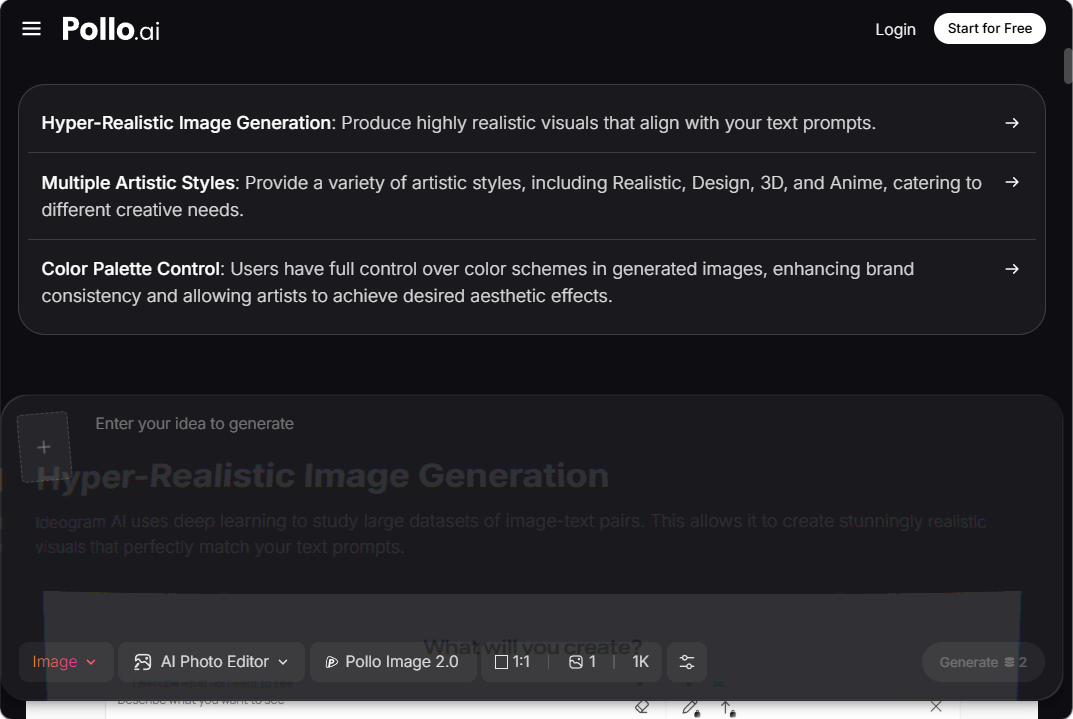
Ideogram AI has carved a distinct position in the AI image space, defined by its industry-leading prompt-to-output fidelity and standout in-image text rendering accuracy. Built on deep-learning models trained across extensive image-text datasets, it consistently delivers visuals that match complex prompts with a level of precision most competing generators struggle to achieve — especially for assets that require embedded text.
Key features and competitive advantages:
- Multi-style creative versatility: Offers pre-built artistic modes including photorealistic photography, graphic design, 3D rendering, and anime illustration, so creators can toggle between product mockups, infographic elements and branded visuals all in one platform, eliminating context-switching costs between specialized tools
- Native brand color control: Features built-in palette customization to define brand-aligned color schemes before generation, removing the tedious post-production step of color-correcting every asset to match brand guidelines for high-volume marketing teams
- Unified workflow within Pollo AI: Integrated into Pollo AI’s Creative Studio alongside video, audio, and avatar modules, enabling users to generate a static image, animate it into a short video clip, and add a soundtrack — all without leaving the workspace
Its core limitation is functional scope. Ideogram AI is purpose-built for static image generation, and does not support video production, voice synthesis, or animated presenter creation. It performs exceptionally well for still-image-only workflows, but requires complementary tools for motion or narration-focused projects.
Akool AI: Video-First Workflows With Virtual Presenters
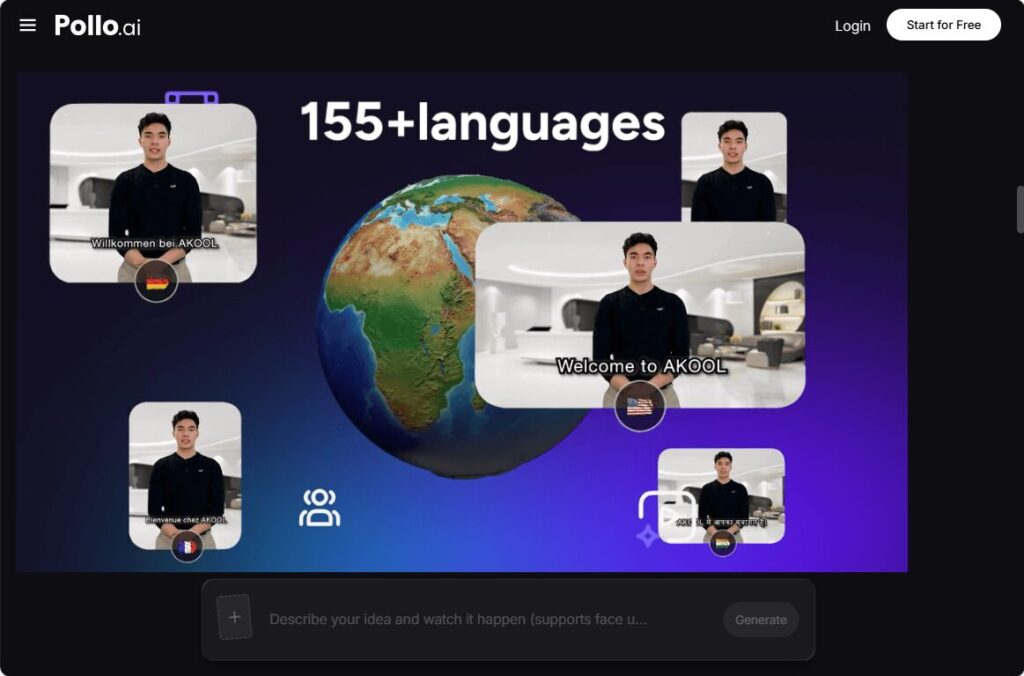
Akool AI approaches creative production from an entirely different angle. Rather than focusing on text-to-image generation, it centers on video content powered by digital human technology and real-time visual transformation, built for live and pre-recorded presenter-led content.
Key features and competitive advantages:
- Live AI studio capabilities: Supports real-time face swaps during live streams, dynamic digital avatars for virtual presentations, and on-camera appearance adjustments for online meetings
- Script-to-video virtual presenter production: Generates finished spokesperson videos from text inputs — simply type a script and select an avatar to receive a realistic digital human delivering your message, with both template-based and custom asset options available
- Enterprise-grade multilingual localization: Delivers lip-synced video translation across global languages, with customizable industry terminology to ensure accurate jargon and specialized vocabulary. A single English product walkthrough can be converted into Spanish, Japanese, German and more with just a few configuration steps, eliminating the need for reshoots or per-market voice talent
Notable limitations for scaled production:
Widely reported performance stability issues, including occasional lag, rendering inconsistencies, and interface glitches that interrupt production workflows
Restricted granular customization depth compared to full-featured video platforms, creating friction for teams that need fine-tuned control over every visual parameter
Same Brief, Different Strengths: A Practical Test
To ground this comparison in reality, both tools received an identical creative brief: produce marketing assets for a fictional organic skincare brand launching a new moisturizer. The deliverables included a hero product image, a social media graphic set, and a short promotional video with narration.
Image Generation
Ideogram AI handled the product imagery with impressive results. A prompt requesting a photorealistic close-up of a glass moisturizer jar on a marble surface with soft natural lighting and eucalyptus leaves produced an image that could pass for a professional studio photograph.
The custom palette feature locked the output to the brand’s sage green and cream color scheme, eliminating any need for color adjustment. Generating three variations for A/B testing took under five minutes. Within Pollo AI’s Creative Studio, extending one of these images into a short animated loop for Instagram Stories required only a few additional clicks in the video module.
Video Production
Akool AI tackled the promotional video component. A sixty-second script describing the moisturizer’s ingredients and benefits was paired with a female digital avatar. The resulting video featured natural-looking lip synchronization and professional delivery. Translating the same video into French and Mandarin for international social channels worked smoothly, with the custom terminology feature correctly handling ingredient names that generic translation engines often mangle.
The quality gap appeared in the details. The avatar’s micro-expressions occasionally felt slightly mechanical during longer sentences, and one rendering attempt produced a noticeable audio desynchronization that required regeneration. These are not dealbreakers, but they add unpredictable time to what should be a streamlined workflow.
Cost and Risk Considerations
Ideogram AI’s pricing within the Pollo AI ecosystem scales with generation volume, making it accessible for freelancers and small teams while remaining cost-effective at higher output levels. The risk profile is low because output quality is consistent and the tool rarely produces unusable results from well-crafted prompts.
Akool AI’s pricing reflects its video-centric feature set, with costs tied to video length, avatar usage, and translation volume. The risk profile is moderate. When the platform performs well, it delivers genuine production savings by eliminating filming, voice talent, and translation expenses. When stability issues surface, the time spent troubleshooting and regenerating can erode those savings.
Deciding Which Tool Fits Your Scenario
If your primary need is generating original, brand-consistent imagery for social media, advertising, packaging mockups, or content marketing, Ideogram AI is the stronger choice. Its prompt accuracy, style versatility, and color control make it a reliable daily driver for visual content production. Pair it with the broader Pollo AI Creative Studio to extend static images into video and audio formats when needed.
If your workflow centers on producing spokesperson-driven video content, multilingual training materials, or live-stream presentations with digital avatars, Akool AI addresses a use case that image generators simply cannot touch. Its translation and face-swap capabilities serve globally operating teams in ways that static tools never will. Just budget additional time for quality checks given the platform’s occasional stability inconsistencies.
For teams that need both high-quality imagery and avatar-driven video, the Pollo AI ecosystem accommodates both tools within a unified creative environment. Generate your product visuals with Ideogram AI, then build your video narrative using avatar and audio modules, all without fragmenting your workflow across disconnected platforms.
Conclusion
Ideogram AI and Akool AI solve fundamentally different creative problems. One generates precise, brand-aligned static imagery with deep color control and multi-style versatility. The other produces presenter-driven video content with real-time face transformation and multilingual translation, though with some reliability trade-offs.
Neither replaces the other, and the most effective creative teams will use both in tandem within the Pollo AI ecosystem, leveraging each tool’s strengths at the appropriate stage of the content production pipeline. Identify whether your current bottleneck is visual asset creation or video presenter production, and start with the tool that addresses your most pressing need.