

There’s a particular kind of panic that sets in when a client’s site goes dark on a Friday evening. You’re not at your desk. Your phone starts buzzing. The support tickets are already stacking up, and whatever plans you had for the weekend are quietly evaporating.
And the worst part? It was preventable. Not in a hindsight-is-perfect way. In a “we knew this infrastructure was under-resourced and kept pushing the conversation to next quarter” way.
That’s where most network reliability failures actually live, not in dramatic hardware explosions or freak incidents, but in deferred decisions that finally run out of runway at the most inconvenient possible moment.
Cloud hosting has made infrastructure more accessible than ever, but accessible doesn’t automatically mean reliable. Those are two completely different conversations, and many teams conflate them until they can’t anymore.
1. Uptime Percentages Are Hiding the Real Problem
99.9% uptime sounds impressive. And technically, it is; that’s roughly 8 hours of allowable downtime per year. But here’s what that number doesn’t tell you: everything that happens in between that isn’t classified as downtime but still quietly degrades the user experience.
Latency spikes. Packet loss. Routing inefficiencies that add 150 to 200 milliseconds to every single request. None of these triggers an official outage alert.
None of them show up in the uptime dashboard. But users feel them immediately, especially on transactional platforms where speed is directly tied to conversion behavior.
There’s a widely referenced finding in e-commerce that a 100-millisecond delay in page load time correlates with a roughly 7% drop in conversions. That’s not a rounding error. That’s revenue leaving through a door nobody thought to watch because the uptime number still looked fine.
The teams building genuinely reliable hosting infrastructure have moved past uptime as the headline metric. They’re watching latency distributions, monitoring packet loss under load, and treating network performance as a holistic discipline rather than a single percentage.
2. The Hardware Conversation Nobody Wants to Have
Software gets most of the attention in discussions of cloud infrastructure. Containers, orchestration, load balancing, CDN strategy — all of it matters.
But underneath every software decision lies physical networking hardware, and the quality of that hardware sets a ceiling that no amount of clever configuration can breach.
This is where cost-cutting quietly does the most damage. Routing equipment at the core of a hosting environment isn’t glamorous, and it doesn’t show up in feature comparisons, so it’s easy to justify cheaper options when budgets get tight.
The problem is that underpowered core routing introduces throughput limitations and inconsistent forwarding behavior that manifest as the unexplainable sluggishness users complain about, but nobody can reproduce in testing.
The cost argument for skimping here has genuinely weakened, though. The Juniper MX204 price range is affordable for what it actually delivers: high-density 100GbE capacity, carrier-grade forwarding performance, in a compact form factor that used to require much larger and more expensive chassis hardware.
For hosting providers and enterprise network teams that need serious routing capacity without a serious physical footprint, that equation has shifted enough to change the calculus.
3. Redundancy That’s Never Been Tested Isn’t Really Redundancy
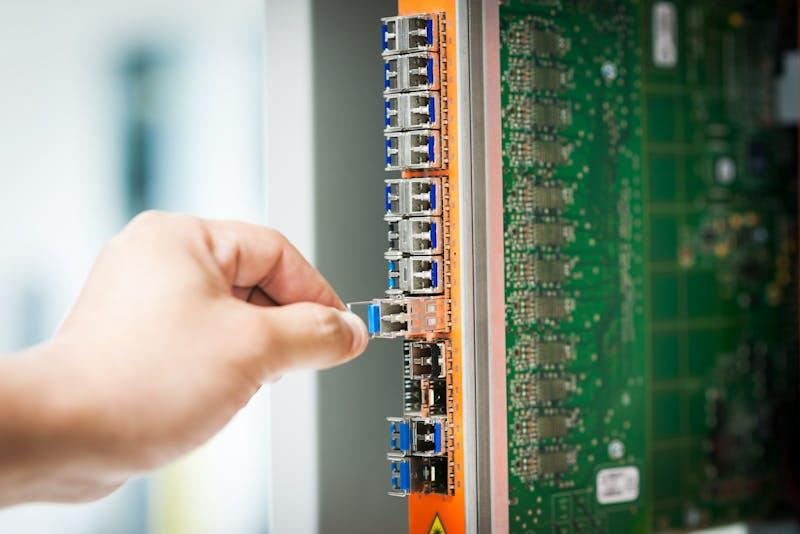
Every hosting environment has redundancy documentation. Backup links, failover configurations, secondary paths, it’s all in the runbook.
What’s far less common is a team that has actually verified what happens when the primary path fails at 11 pm on a Tuesday with real traffic running.
Untested redundancy is expensive false confidence. The failover might technically work, but take 45 seconds to complete, which the application layer interprets as a full outage.
The backup path might have enough capacity for normal traffic, but collapse under the load that shifted to it during the failure. These aren’t edge cases — they’re the predictable outcomes of redundancy that was architected but never stress-tested.
Access layer stability is its own separate piece of this. When teams buy Juniper EX4400 switches for their campus or data center access layer, they get Virtual Chassis support, a robust stacking architecture, and a high-availability design that keeps the layer stable even during individual component failures.
It’s the kind of decision that prevents problems from ever propagating upward into application-visible incidents in the first place.
4. Latency Is Quiet and Expensive and Underreported
The outage that takes a site completely offline generates immediate urgency. Tickets fly, engineers scramble, post-mortems get written. It’s visible, and it gets fixed.
Chronic latency degradation is the opposite. It’s quiet. It distributes its cost across conversion rates, session lengths, user retention, and API response times in ways that are hard to attribute directly to a network problem.
By the time someone connects the dots, the damage has been accumulating for months across dashboards that nobody linked together. This is why latency deserves the same level of operational attention as uptime.
Not because it’s more dramatic, it’s actually the least dramatic infrastructure problem you can have, but because the compounding cost over time is substantial, and the root cause is usually fixable if someone decides to actually look.
Reliability Is a Discipline, Not a Configuration
The hosting environments that stay genuinely stable over time aren’t running on better luck. They’re run by teams that treat reliability as ongoing work rather than a milestone you hit during setup and then stop thinking about.
That means load testing under realistic conditions, not just green-field benchmarks. It means hardware refresh cycles that get reviewed before equipment becomes a bottleneck.
It means monitoring that surface degradation while it’s still minor rather than after it’s already affected users.
And honestly? It means having the budget conversations earlier. The deferred infrastructure upgrade that seems reasonable in a quarterly review almost never looks reasonable in an outage post-mortem. The math just doesn’t work in favor of waiting.
Nobody celebrates when the network stays stable for a year straight. There’s no announcement, no dashboard milestone anyone screenshotted and shared. The users just keep using the product without thinking about it. That’s exactly what you’re building toward.